I have been talking a lot lately about using ServiceNow as a tool to deliver unified end-user experience and governance for multi-cloud architectures. Most organizations today have multiple clouds public and private. This hopefully helps provide the best suitable landing zone for every workload.
However, the mainstream approach to consuming public cloud is to give developers a credit card and say “here you go”, which is not a good governance best practice. So it doesn’t come as a surprise when an outrageous bills come at the end of the month. The other big issue with this approach is that every cloud becomes a silo. On the positive side, developers get more productive and deliver value to the business faster.
In videos like this one you can see how it is possible to deliver a unified multi-cloud experience across multiple public and private clouds. The example uses ServiceNow but it will work for other tools like it. The principle is to offer the same type of item with comparable T-shirt sizes from a single catalog in ServiceNow. You will notice in the video how the user can see what the same VM costs on each cloud. When you pair this with chargeback, it helps developers to make the right decision as to where to run a workload. You can also throw into the mix approvals based on the characteristics of the item (ex: is the storage capacity larger than a certain amount? does the VM require too much RAM or a GPU? does the VM cost more than $100 a month?) as well as CMDB integration for resources in all clouds, etc.

The governance benefits are enormous but developers are not equally impressed. They like to use tools like Terraform or Ansible to provision their environments at the speed of light (almost) and they will argue that going to a GUI like a ServiceNow catalog makes them slower. And of course, when developers use “Infrastructure as Code” directly on the public cloud they bypass all the governance.
By now, probably you can guess where I am heading: is there a way of reconciling both views of the world? Ultimately the key to delivering agility via automation is having an API … and ServiceNow has a great REST API. In particular, you can order items from a service catalog using the REST API, which means that developers can order catalog items using a tool like Terraform or Ansible but still be subjected to the guardrails that the governance policies have put in place
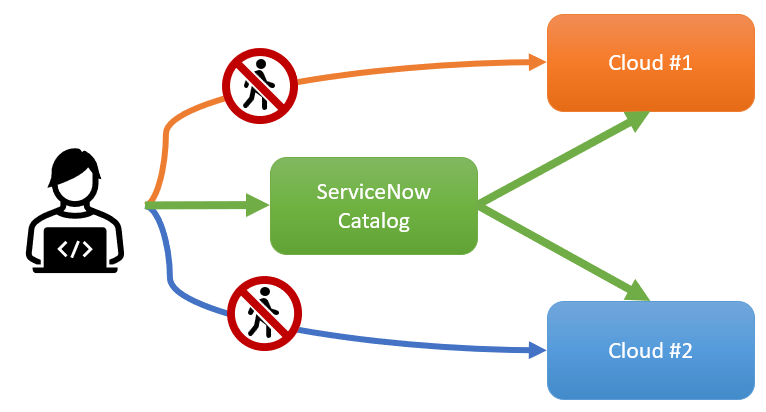
With this approach:
- the organization creates a unified governance and end-user experience for all public and private cloud resources
- developers can use Infrastructure as Code tools and processes that make them agile
- the same REST API provides programmatic access to resources in all clouds
- approvals and other control processes remain in place and it is easier to keep costs under control
If you are interested in the details of how to do this, you can visit my previous post about how to create requests from a ServiceNow catalog using Ansible and Postman (what about Terraform?)
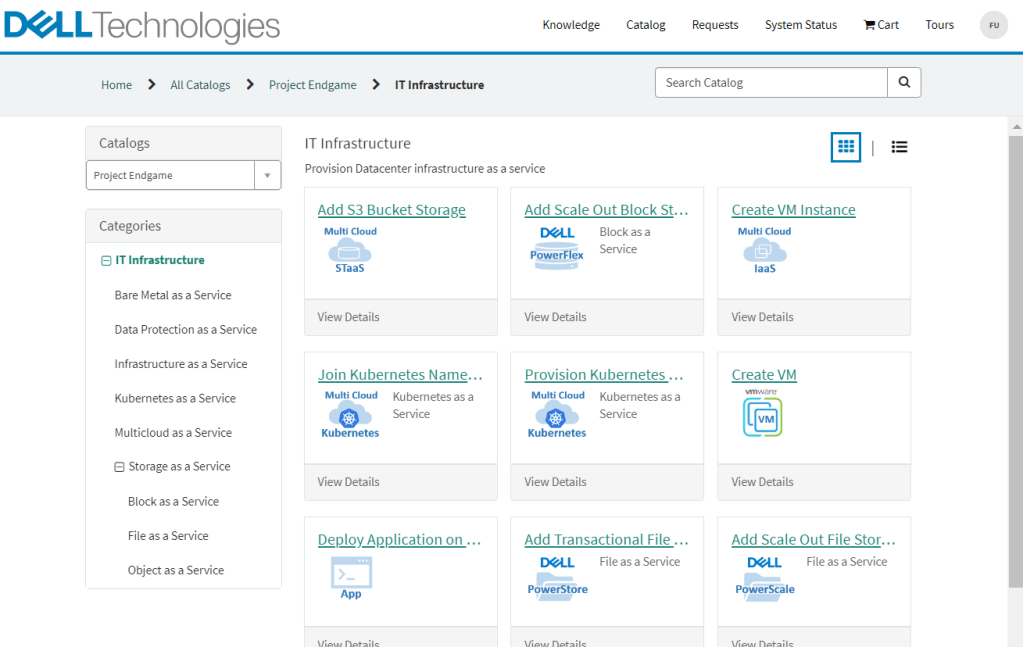
Let’s see an example of how it works in practice. This is our infrastructure catalog. It allows the user to consume infrastructure from private and public cloud. We are going to use a STaaS (Storage-as-a-Service) as an example because the approvals are very intuitive. This catalog item allows you to provision file storage to an existing virtual machine. This item includes a capacity-based approval. The idea is that any request for more than a certain threshold is going to require an approval. You could have additional thresholds that require 2 or potentially VP approval. You can see how this constraint is going to encourage reasonable consumption by the end users. No one likes to wait for anything these days. In this demo environment the threshold is set very low, to just 50GB.
The objective is to use code to order storage for a VM and demonstrate that:
- if the capacity requested is lower than the threshold the request goes straight through
- if the capacity requested is above the threshold the approval process kicks in
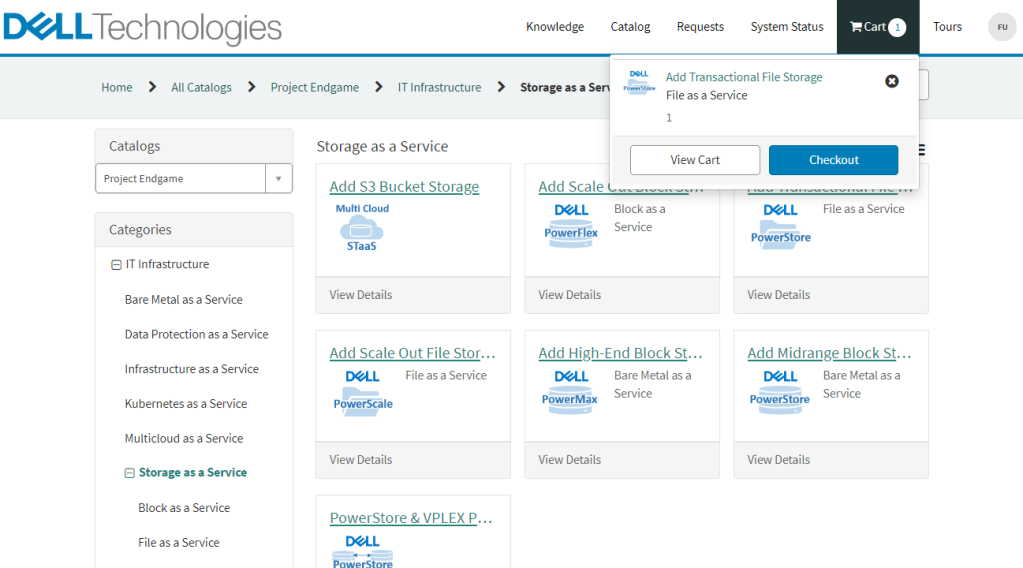
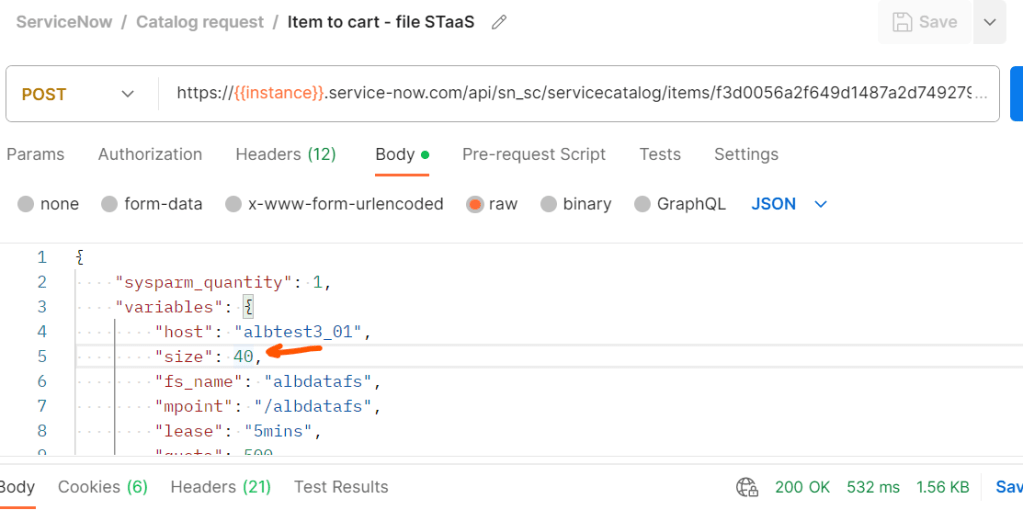
We are going to use Postman to do this demonstration. You can find the Postman collection I am using in this GitHub repo. The process has essentially 2 steps: add an item to the cart and finally submit the cart. Here you can see we have sent a REST API call to add the File STaaS to the cart

URL needs the sys_id of the catalog (get it from URL) or programmatically (with this API call). The payload needs to include quantity and all the variables required. You can find out the variables required using this API call. The status code will be 200. At this stage you can see there is 1 item in the cart
The second step then is to submit the cart. We can do so with this REST API call. Note how it is also a POST call but it doesn’t require a Body parameter. It feels intuitive that you might have to at least specify the cart ID, but this is not necessary because a user only has one cart.
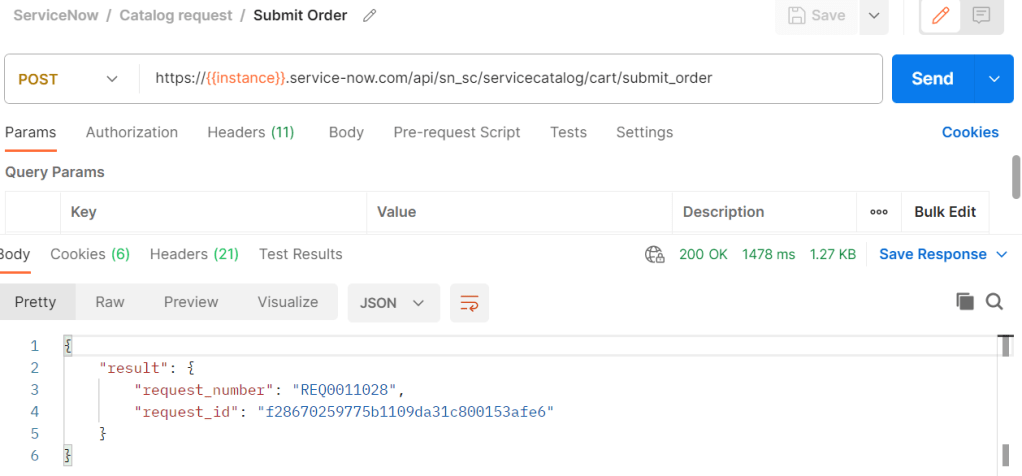
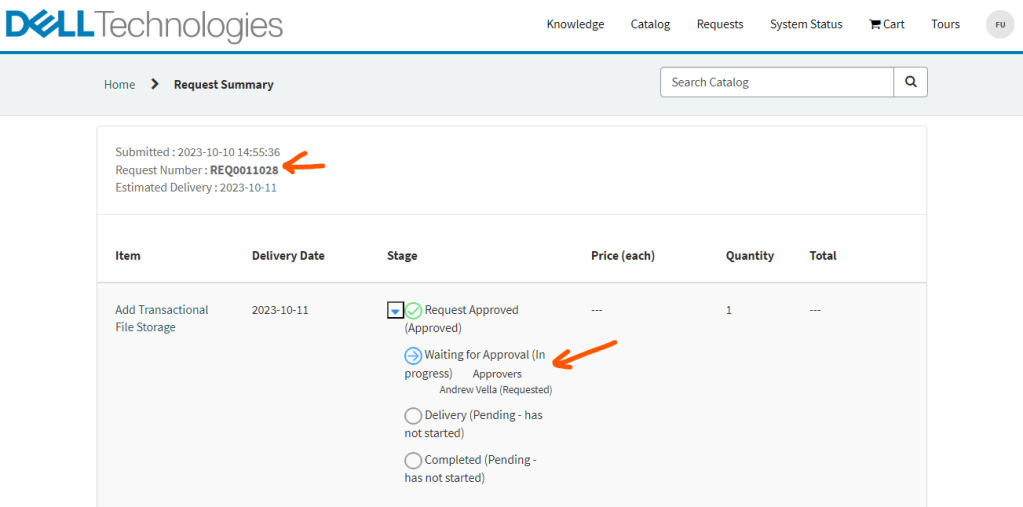
You can see request “REQ0011028” was created. If I navigate to “Requests” for the user we can see the status of the request. The approval process is triggered because we requested 60GB which is more than the threshold. This is good because we can use Infrastructure-as-Code tools to provision infrastructure while maintaining governance.
A key ingredient to make this both agile and useful for the business is to be wise with the thresholds. Your organization should consider what threshold provides the 80/20 or even perhaps the 90/10 rule so that the majority of provisioning activity can happen without delays.
To finish off let’s repeat the request but this time the capacity required will be 40GB which is under the threshold.
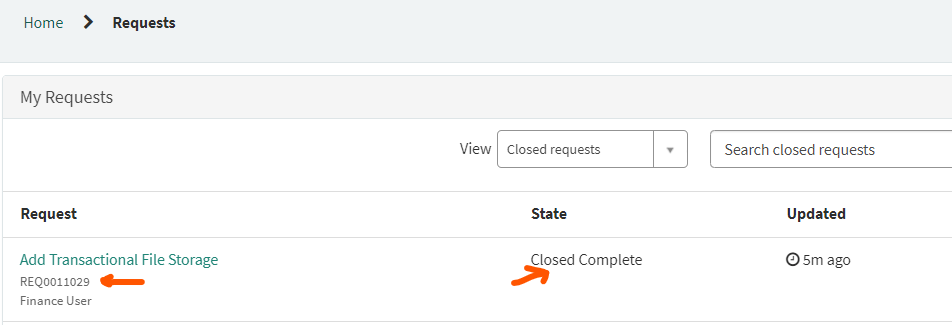
This time, when we go to “Requests” we can see that the request is already complete. It didn’t need an approval.
If I log in to the Virtual Machine straight away I can see that the storage has been created, mounted and configured. As you can see I can even create a file on it.

Conclusion
Many organizations are implementing private clouds to that deliver a self-service experience to end-users by implementing automation and exposing it to users via an ITSM tool like ServiceNow. This architecture can be extended to consume also public cloud resources in such a way that a consistent end-user experience is delivered regardless of where the resources are created. This also brings an opportunity to break down silos and create a unified governance framework for all clouds along with integrated CMDB and incident management. This is very important especially now that cost control has become paramount. On the other hand developers demand accessing resources via API so that they can iterate faster and deliver more value to the business. In this blog post we have demonstrated how developers can leverage the ServiceNow REST API to automate the provisioning of resources in any cloud at the speed they need without jeopardizing governance.

 {{ vExpose }}.Blog
1 reply »